Why Freight Pricing Feels Confusing for So Many Businesses
One of the most common things we hear at Canadian Freight Quote is:
“I got three freight quotes for the same shipment : why are they all different?”
If you’ve ever felt confused or unsure while comparing freight prices, you’re not alone. Freight pricing in Canada depends heavily on how your shipment moves, and the biggest decision is usually between LTL (Less Than Truckload) and FTL (Full Truckload).
Understanding the difference can save you money, time, and frustration.
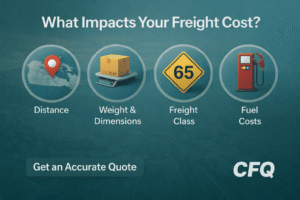
What affects freight shipping costs in Canada?
Carriers and freight providers consider several details when pricing a shipment:
- Distance and route: The origin, destination, and route affect transportation costs.
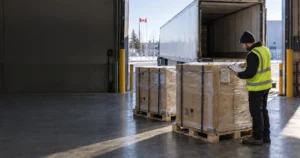
- Weight and dimensions: Carriers need accurate measurements to determine how much capacity a shipment uses.
- Freight class or commodity details: For LTL shipments, the freight’s characteristics and classification may affect the rate.
- Shipment type: Palletized freight, loose cargo, and other shipment formats may have different handling requirements.
- Equipment and service needs: The required vehicle or service level can affect pricing.
- Fuel and market conditions: Fuel costs, carrier capacity, and demand on a particular route can influence rates.
- Pickup and delivery requirements: Access, timing, and handling details may affect the services needed.
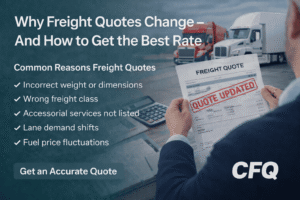
A quote is only as accurate as the information provided. If shipment details change—or important details were missing— the final charge may differ from the original estimate.
LTL freight pricing
Less-than-truckload (LTL) shipping is used when a shipment does not need an entire truck. Your freight shares trailer space with other shipments, and the price generally reflects the space and services required for your load.
LTL may be worth comparing when you’re shipping a smaller commercial load, such as one or a few pallets, and the shipment does not require a dedicated truck.
LTL pricing can depend on:
- Freight class or commodity information
- Weight and dimensions
- Pickup and delivery locations
- Carrier availability and route conditions
- Fuel costs and any additional service requirements
Accurate dimensions and shipment descriptions are especially important. Incorrect or incomplete details can lead to a reclassification or a rate adjustment.
FTL freight pricing
Full-truckload (FTL) shipping uses a truck dedicated to your shipment. It may be suitable for larger loads, shipments that need dedicated capacity, or situations where reducing handling is a priority.
FTL pricing commonly considers:
- The origin, destination, and distance
- The amount of truck capacity required
- Equipment type
- Fuel costs and current route demand
- Pickup and delivery requirements
FTL is not automatically more expensive than LTL for every shipment. For some loads and routes, comparing both options may help identify the better fit. The right choice depends on the shipment details and the available service options.
LTL vs. FTL: Which should you compare?
Consideration | LTL | FTL |
| Typical use | Smaller loads that do not need a full truck | Larger loads or shipments needing dedicated truck capacity |
| Truck space | Shared with other shipments | Dedicated to your shipment |
| Pricing factors | Shipment details, freight class, route, and handling | Route, capacity, equipment, fuel, and service needs |
| Best next step | Provide accurate weight, dimensions, and freight details | Provide load size, route, and equipment requirements |
Neither option is best for every shipment. Compare the service options using the same shipment information, then consider price alongside timing, handling, and the requirements of your goods.
How to help get an accurate freight quote
Before requesting a quote, gather the details that describe your shipment:
- Pickup and delivery locations
- Number of pallets or pieces
- Weight and dimensions
- Product or commodity description
- Packaging type
- Any special handling or shipment requirements
Include complete and accurate information from the start. If any shipment details are uncertain, flag them when requesting the quote so they can be clarified before you make a decision.
Get a freight quote
Freight pricing depends on the shipment, route, and service requirements. Canadian Freight Quote helps businesses compare available freight options for their commercial shipments.
Share your shipment details to request a quote and compare the options that may fit your needs.
FAQs
What is the difference between LTL and FTL freight?
LTL shipping shares truck space with other shipments, while FTL uses a truck dedicated to your load. The appropriate option depends on shipment size, route, timing, and service requirements.
Is LTL always cheaper than FTL?
No. LTL is often used for smaller loads, but the best-value option depends on the shipment and route. Comparing available LTL and FTL options can help you make a more informed choice.
Why can freight quotes for the same shipment be different?
Quotes may reflect different carrier options, route conditions, service requirements, or assumptions about shipment details. Check that each quote is based on the same weight, dimensions, pickup and delivery locations, and service needs.
Can the final freight charge change after a quote?
It can change if shipment details or service requirements differ from the information used to prepare the quote. Providing accurate details and confirming any changes can help reduce unexpected adjustments.
What information should I provide to get a freight quote?
Be ready to provide the pickup and delivery locations, shipment quantity, packaging, commodity description, weight, dimensions, and any special requirements.